
A Tale Of Two Six
A superstar native son, a homecoming-inspired final album, and how Fayetteville, North Carolina—if only for a weekend—became the center of the hip-hop universe.
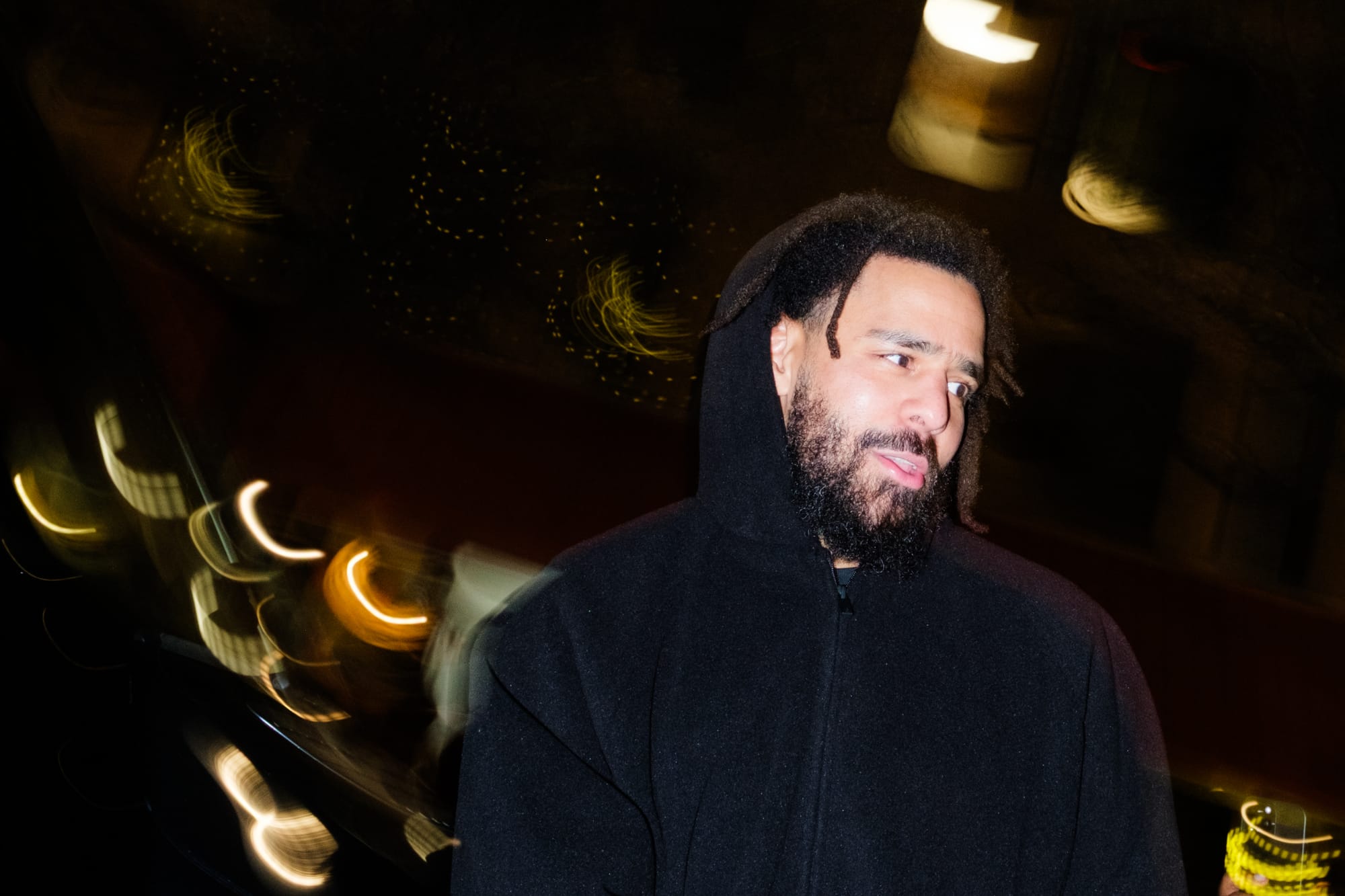
This story is published in partnership with The Assembly. It appears in the first print edition of Super Empty magazine, releasing later this month. Subscribe now and be among the first to receive it.
The first thing you notice on Forest Hills Drive is the lack of street signs.
Bookended by Mulberry Street to the east and Cain Road to the west, there are only two signs announcing the short, leafy lane northwest of downtown Fayetteville. You’ll find signs for the three cross-street cul-de-sacs that branch off of Forest Hills, but the main stretch is entirely unadorned. On December 9, 2014, rapper J. Cole released his third album, 2014 Forest Hills Drive, named after his childhood home. Since then, fans, usually in their teens and 20s, would show up in the quiet neighborhood to abscond with one of the street signs, a souvenir to prove they’d been to the hallowed ground where their hero grew up. By May 2018, the city had replaced 51 of them. Instead of adding new ones, it raised the signs at the north and south ends to 18 feet high.
The house at the eponymous address, set back from the road and boxed in by a shabby picket fence, has the unassuming charm of ‘70’s southern suburbia. It’s 1,000 square feet, small but livable, a mix of brick and wood exterior. The asphalt shingle roof seems perpetually covered with pine needles dropped from the massive surrounding trees. It’d be unremarkable if it weren’t essentially a national landmark, and yet the house seems to have its own gravitational pull—an energy that permeates the surrounding air like a fine mist.
Each fencepost is covered in scribbles, mostly names and initials of loyal listeners documenting their visit. A metal mailbox hangs near the driveway gate, and inside are two weather-beaten composition notebooks, each page filled with messages of praise, admiration, and gratitude for Fayetteville’s begotten son.
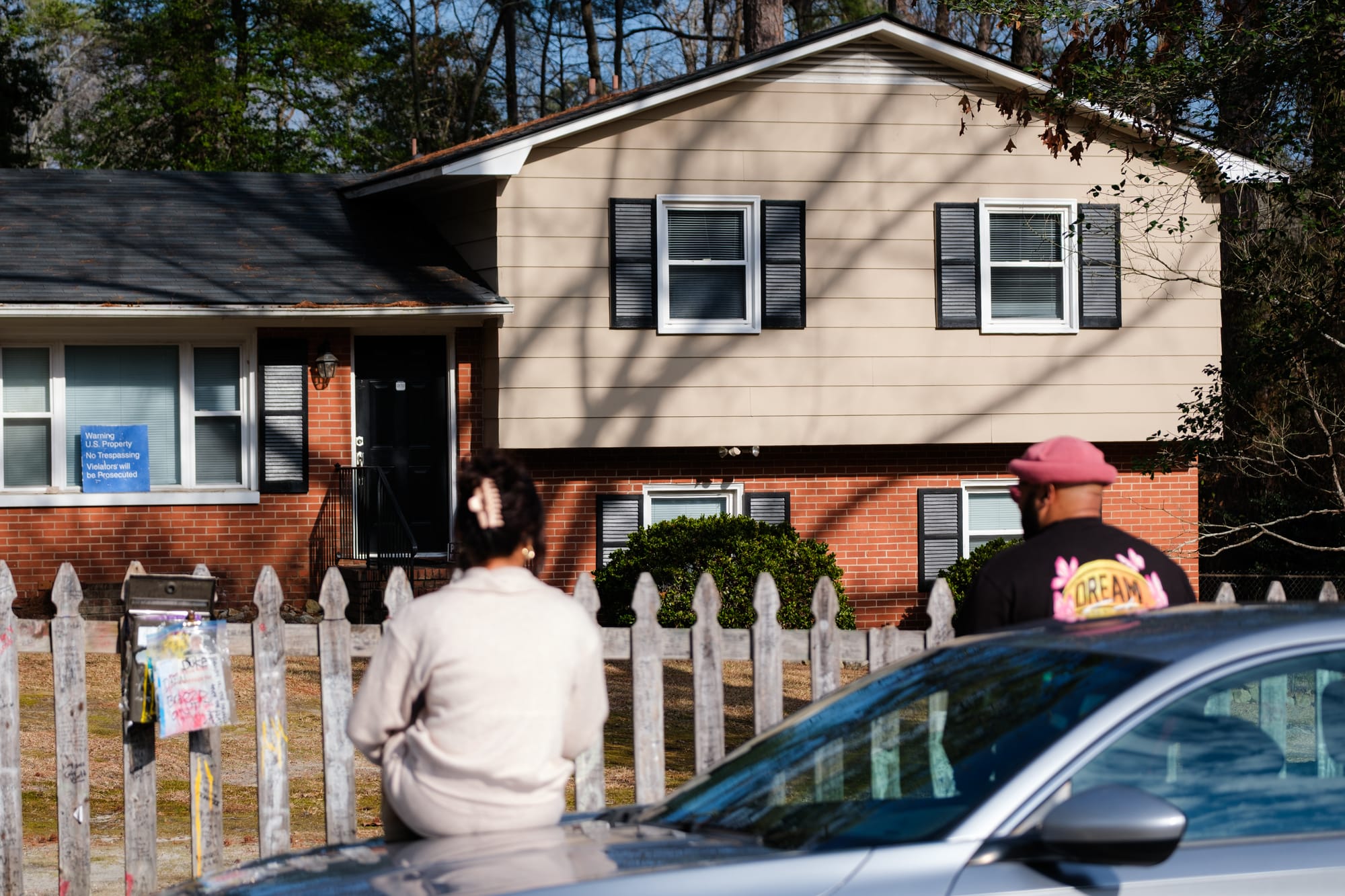
When Cole released his seventh—and purportedly final—album, The Fall-Off, on February 6, more visitors trickled in at Forest Hills Drive to pay homage. Kyahna Santos, a 33-year-old Californian who’s lived in North Carolina for more than a decade, drove down from Raleigh, parked along the picket fence, and pressed play on the double album. A diehard Cole fan, she’d promised herself that as soon as she was able, she’d trek to Fayetteville. “Every time he puts out an album, it’s right when I need it,” she said. “It always motivates me to do better.” Though Santos hoped for a private experience, it soon became clear that many others planned the same pilgrimage. She stayed in front of the house for the album’s hour-and-41-minute runtime, keeping it playing as she chatted with her fellow travelers.
One of the first people Santos spoke to that afternoon was Darrell Oxendine, a 39-year-old single father from Lumberton, about 45 minutes south of Fayetteville. He knew he wouldn’t be able to make any of the listening parties around town that night, so he decided to swing by Forest Hills Drive after dropping his kids off at school. He’d stopped at the house briefly in 2024, but felt as though some magnetic force was guiding him there again. To Oxendine, the house is less a tourist destination or a curiosity than a beacon, a symbol of possibility and hope for those who share the 910 area code.
“Your walk of life, your financial situation, your structure at home—none of that matters,” said Oxendine. “It’s attainable.” To him, Cole cuts a figure both modest and mythical, a star the size of the sun still close enough to touch. The writing on the fence, the scribbled missives in the mailbox, the strangers pulling up and greeting each other with, “So, what’s your favorite project?” all confirm to him that Cole has compressed the space between himself and his audience. That Cole would spend the next several days touring college campuses, selling the new album from the trunk of an old Honda Civic, only made Oxendine’s point more poignant.
On the cover of 2014 Forest Hills Drive, Jermaine Lamarr Cole sits on the roof of the house, eyes locked on some distant point. It reads like a magnate surveying a conquered landscape, ready to expand into new, unknown territory. Cole was already a minor star by this point, a “B-list celebrity,” as he terms himself on “No Role Modelz,” that record’s biggest single and Cole’s most-streamed song to date. He left Fayetteville for New York City in 2003 on a scholarship to St. John’s University, tackling the dual pursuits of a communications degree and a record deal. His dream was to work with Jay-Z, and he tried everything he could think of to get into the legend’s orbit: MySpace messages, studio internships, hanging out where he recorded, armed with a beat tape demo and a bottle of E&J.
Eventually, Cole connected with Mike Rooney, who became his first manager. Through Rooney’s connections, Cole’s music finally landed in front of Jay, who made him the first signee to Roc Nation in February 2009. His first two albums for the label, 2011’s Cole World: The Sideline Story and 2013’s Born Sinner, were massive successes, going platinum and double platinum, respectively. But 2014 Forest Hills Drive was a barn burner, a highly personal album with no features that sold six million copies. Tying his breakthrough album so directly to his hometown felt like a victory lap, both a tacit admission that he’d outgrown his modest beginnings and a loving embrace of the city that made him. “The real is back, the ‘Ville is back,” he exhales on “January 28th,” the song named for his birthday.

Cole began writing raps in his adolescence, inspired by the likes of Nas, Eminem, and Canibus, emcees who combined knotty concepts with knottier rhyme schemes. By 14, he had filled several stacks of notebooks and was eager to step into a world larger than his bedroom. The small but bubbling talent pool in Fayetteville began to catch his ear, as crews like Blaque Watch, Zef Lesson, and Open Eyes started to make noise.
Bomm Sheltuh, the duo of Nervous Reck (born Brion Unger) and Filthe Ritch (born Carlos Brown), had the most exciting buzz. They’d started working together in the late ‘90s, operating out of Nerv’s childhood home in the Old Ponderosa neighborhood he’d converted into a studio. Just after Nerv graduated from high school in 1995, his father was sent to another Air Force Base. Nerv stayed behind, renting the house he dubbed The Sheltuh from his parents. It became a creative nucleus for the greater Fayetteville hip-hop scene.
“Carlos and I were already established at that point, but that just really solidified everything and took it up another level,” Nerv says. They were free to pour themselves wholly into the music, with various rappers and producers from all over the city coming through to work at all hours.
The duo released a well-received album, Food, Clothing & Sheltuh, in 2000, and Cole picked up a copy during a visit to Paradise Records, a now-shuttered shop once located at McPherson Church and Skibo Roads. Nerv and Filthe’s contact information was on the album’s back cover, and Cole began chatting with Nerv on AOL Instant Messenger. For five days in a row, he sent messages, usually something innocuous like, “Hey, man, what’s up?” Nerv, wary of pop-ups, waved them off, thinking his computer had been infected with a virus. By the fifth day, Cole seemed to notice that this was getting him nowhere, so he got more specific, and, as Nerv puts it, “informative”: “‘My name is Blaza, I’m a rapper, and I really like y’all.’” Nerv, realizing these messages were real, responded, inviting him to Bomm Sheltuh’s upcoming gig at Duh Skatezone.
One of the major hurdles for artists in a small city like Fayetteville, an issue that continues to some extent, is a lack of infrastructure. Venues that specialize in hip-hop don’t seem to last long enough to become a centralized hub, while other venues shy away completely from booking rap shows. Radio stations are increasingly under corporate umbrellas, adhering to a national playlist that draws on few local acts. In the early 2000s, Duh Skatezone, a skate park and DIY music venue founded by local skater Terry Grimble, was one of the few places in Fayetteville for musicians to gather, build, and perform.
After noticing that he and his friends stayed out of trouble when skating, Grimble started the nonprofit Skaters of Fayetteville at age 18, lobbying the city council to build a youth-accessible park. The group had to come up with half the money, so Grimble and his friends started throwing house shows, charging $5 a pop. They later moved to a 5,000-square-foot section of a sports complex, but quickly outgrew it. Grimble and the owner of the complex transformed a much bigger space on McPherson Church Road and opened Duh Skatezone in the spring of 1999. “It was sectioned off in a way where the first quarter of it was a small venue. You could put 300 people in there if you really packed them in,” Grimble says. “That’s perfect for local shows, because most of the time we’d only get 120 people, on average.”
On February 25, 2000, Bomm Sheltuh played the first hip-hop show at Duh Skatezone, setting off a run that solidified Fayetteville as a prime southern stop for many major rap tours, hosting acts like Mobb Deep, Lil Jon and the Eastside Boys, Fat Joe, and State Property (though it shut down barely two years later). That night, Nerv and Filthe invited Cole, then a 14-year-old performing under the name Blaza, on stage to rap a few verses. “I thought, ‘Damn, he’s got a lot of potential,’” Nerv recalled. His instincts proved right, as nine years later, Cole would become one of the biggest rappers in the world.

Nerv, who now lives in Durham, decamped to Raleigh in 2004 to attend music school. He started a screen-printing business with Justus League rapper Sean Boog and his brother, Chris, focusing more on the shop than music, until a 2023 phone call from Cole encouraged him to get back in the game. He started DJing in the Triangle on occasion and founded a label, The Sheltuh. Having kept an eye on talent in the ‘Ville, he recently signed Fayetteville rapper PFG.
Nerv was back in Fayetteville the week of The Fall-Off’s release to attend and testify in the trial of Joshua Tashun Joyce, the man who murdered Carlos Brown (Filthe Ritch) in May 2023. Brown had fallen on hard times, his home having been burglarized during a stay in Durham, and he’d been living in his car as a result. He and Joyce knew each other and had been arguing on social media about the terms of a loan Brown had given Joyce. Things spiraled, and Joyce, after threatening to come find Brown, shot and killed him on a friend’s porch. Brown had been planning to move to Durham to restart Bomm Sheltuh with Nerv.
Just before our interview, a jury at the Cumberland County Courthouse delivered a guilty verdict. Jones was sentenced to 20 to 25 years in prison. “It’s poetic justice,” Nerv says, “because it’s on Two Six and Cole’s album just dropped.” A week after Brown was killed, Nerv was on the phone with PFG, laying out his vision for the label. “It’s almost like Filthe’s spirit was there, saying, ‘Here goes the next guy.’” “SAFETY,” the third song on The Fall-Off, specifically mentions Brown’s murder.
After the impressive Skatezone performance, Nerv took Cole under his wing and invited him to the Sheltuh. “At first, he was just a fly on the wall, kind of quiet, trying to soak up everything. Eventually, I started teaching him how to make beats.” He showed a young Cole the ropes of his Ensoniq ASR-10 and Akai MPC2000 samplers. Cole’s mother finally bought him an Ensoniq ASR-X Pro after a year of pestering, deepening his knowledge of beat machines. He’d continue to write and record with Nerv and Filthe, changing his name from Blaza to Therapist at Filthe’s urging. You can still find the fruits of some of those sessions online, and if you’re lucky enough to possess a copy of Fayettenam Bommuhs, a compilation of Fayetteville rappers, or I’ll Sleep When I’m Dead, Nerv’s first solo record, you have some of the first J. Cole material put to tape.
The photo on the cover of The Fall-Off, a snapshot of Cole’s teenage workstation, is much more humble than that of 2014 Forest Hills Drive. Wedged in between a tall speaker and a stereo tower sits a tiny, cluttered desk, covered with stacks of CDs and notebooks. Nestled amongst the bric-a-brac is the ASR-X. Faded and torn, the photo looks like it was rescued from a scrapbook left in some long-forgotten junk drawer. It’s the most intimate image Cole, now 41, has included on a release, signaling the album’s insular, personal feel. Across two discs, each inspired by trips back to Fayetteville at ages 29 and 39, Cole uses his memories of the city to examine his identity and experiences.
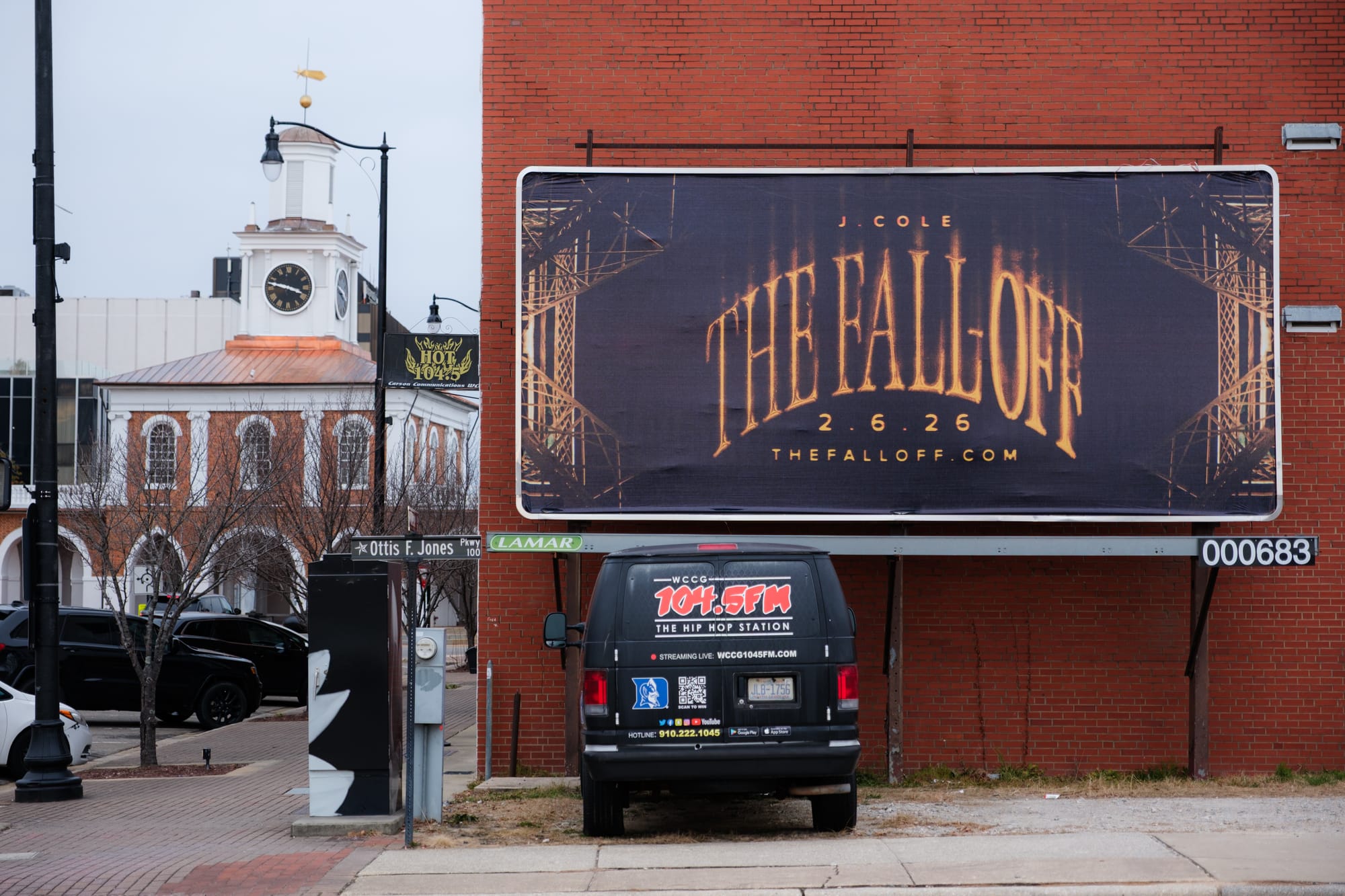
Much like the massive Fall-Off billboard campaign peppering the city, Fayetteville is everywhere on the album. “It’s a love letter to the ‘Ville,” says director and filmmaker Mark Mayr, facilitator of the Two-Six Cypher, a celebration of and tribute to the local scene. “Two Six,” the first song on The Fall-Off, sets the tone: It takes its title from the city’s nickname, itself cribbed from the Cumberland County jail code, which has become a rallying cry. During its hook, Cole shouts “AnnnANT,” the response any local will give after you call out the digits. The video for “Two Six” is shot largely downtown and prominently features the Market House, a site where enslaved people were once sold, which now marks where all points of the city converge.
He paints a detailed map of the ‘Ville, shouting out Bunce Road, The Murk (Murchison Road), and Bragg Boulevard, neighborhoods like Bonnie Doon, Eutaw, and Haymount, and landmarks like Cross Creek Mall and Tera Gardens apartments. He spells the name of the city in the chorus of “and the whole world is the ‘Ville,” cribbing the cadence from the early 2000s group Ground Zero’s song, “Fayetteville.”
Setting The Fall-Off’s release date for February 6, 2026—2/6/26—essentially created a new holiday for the city. Cole is its avatar, an inextricable part of its identity. There are at least three murals of the rapper around town, and many businesses, like Gallery 13 on Hay Street and Back Around Records on Market Square, prominently feature art of Cole’s face. Many downtown businesses advertised release day listening parties, the most prominent of which were at 104.5 WCCG’s studio headquarters and The Sip Room, a wine bar on one of downtown’s busier corners. All day, The Fall-Off blared at top volume out of car windows and open front doors. People greeted each other in the streets: “Today’s a big day, bro!”
That night, standing outside 104.5’s cramped offices, DJ Ricoveli broke down the impact The Fall-Off had on the city. “Cole brought the community together,” he said, pointing to the crowd inside, his voice swelling with pride. “It ain’t usually like this.” He wasn’t alone; you couldn’t walk a block without hearing someone express something similar. At the Omni Cinemas 8 theater the night before, Mayr had arranged to premiere the 2026 Two Six Cypher, which Ricoveli hosted and closed out with a fiery verse. He announced the show on Wednesday, and it capped out within three hours. Representatives from all corners of Fayetteville’s creative class—Fayetteville Observer contributor Keem Jones and FayNC Magazine Editor-in-Chief Zairis TéJion, radio personality DJ Yodo, participants Tony Love and Mac DaBlackSheep, Grimble—were in attendance for a scene that felt as special as it was rare.
Mayr, who recently moved back to Fayetteville after eight years in Los Angeles working in video production, created the first Two Six Cypher in 2015 as a “going away gift to the city” before leaving for California. He’d wanted to do another one for a while, and the idea of putting it out on February 6, 2026, felt like the stars had aligned. “It’s the year of Two Six,” Mayr remembers thinking. He started planning last fall, gathering a team and gauging interest from rappers and producers, long before he heard Cole was releasing The Fall-Off on 2/6/26. “It was a divine timing, serendipitous thing,” Mayr says, a hint of shock still lingering in his voice.
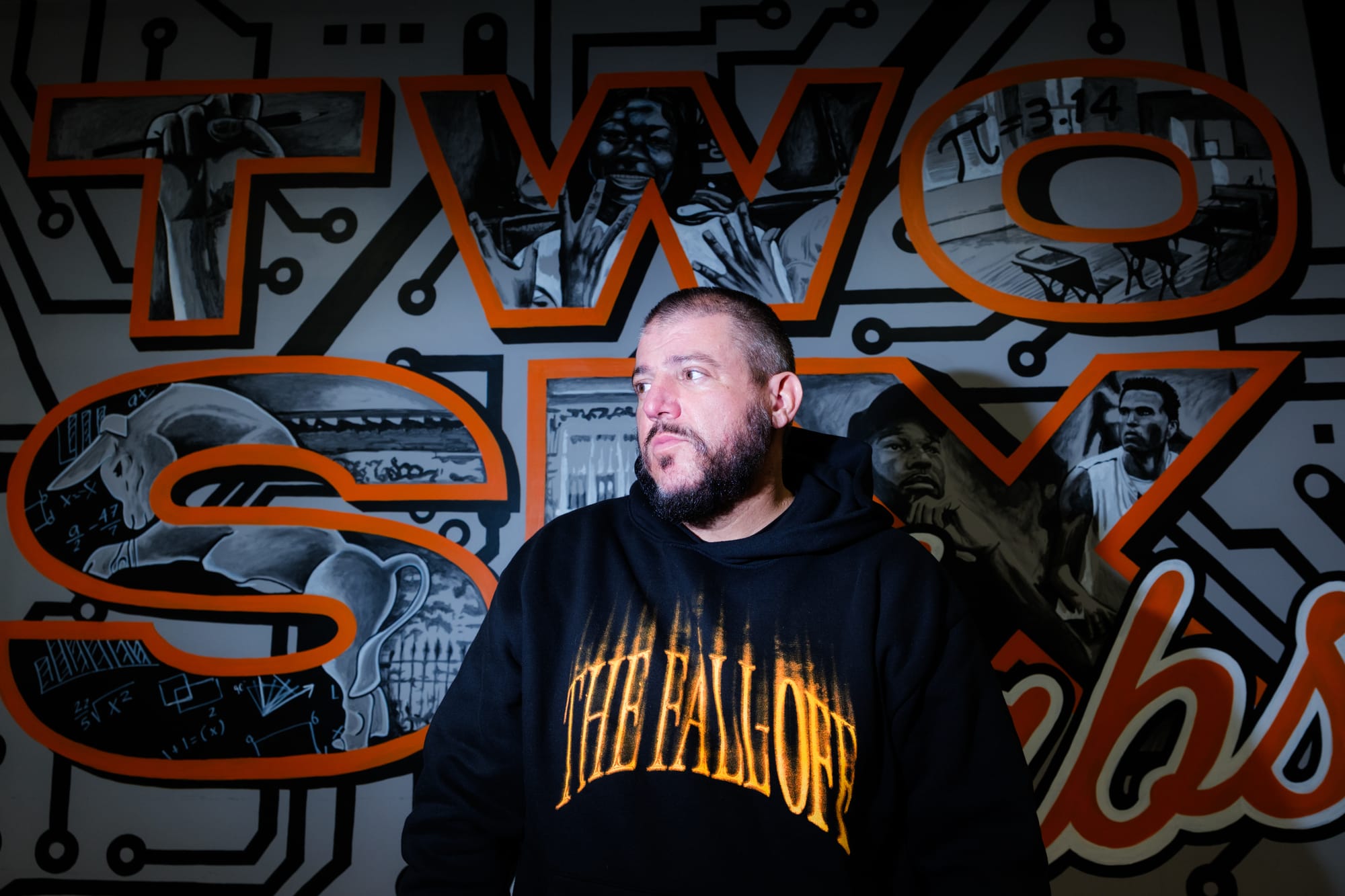
It’s as much a love letter to the city as The Fall-Off, as “Two Six” easter eggs appear everywhere: It was shot entirely at 2-6 Labs, a creative space in the historic Orange Street School, the rappers gathering in front of a massive “Two Six” mural. Six producers provided beats, and two rappers performed on each.
The premiere set the mood for the weekend, and by Friday evening, the city was crackling. Cole fans gathered at Game Day Kutz & Apparel to shoot pool and blast The Fall-Off at deafening levels. A cypher jumped off outside of Bruce’s Sports Bloc & Lounge. As the night wore on and the parties began to fade, a massive throng of people ran into The Sip Room, frantic and fevered. Cole was in the building.
When word got out, every partygoer downtown descended on the wine bar, jostling to dap him up or take a blurry selfie. Cole didn’t rap along to the music or give a speech; he just stood in the middle of the room, smiling, graciously greeting as many people as he could. “I touched an arm, I’m good,” swooned a starry-eyed woman to her friends as he brushed past.
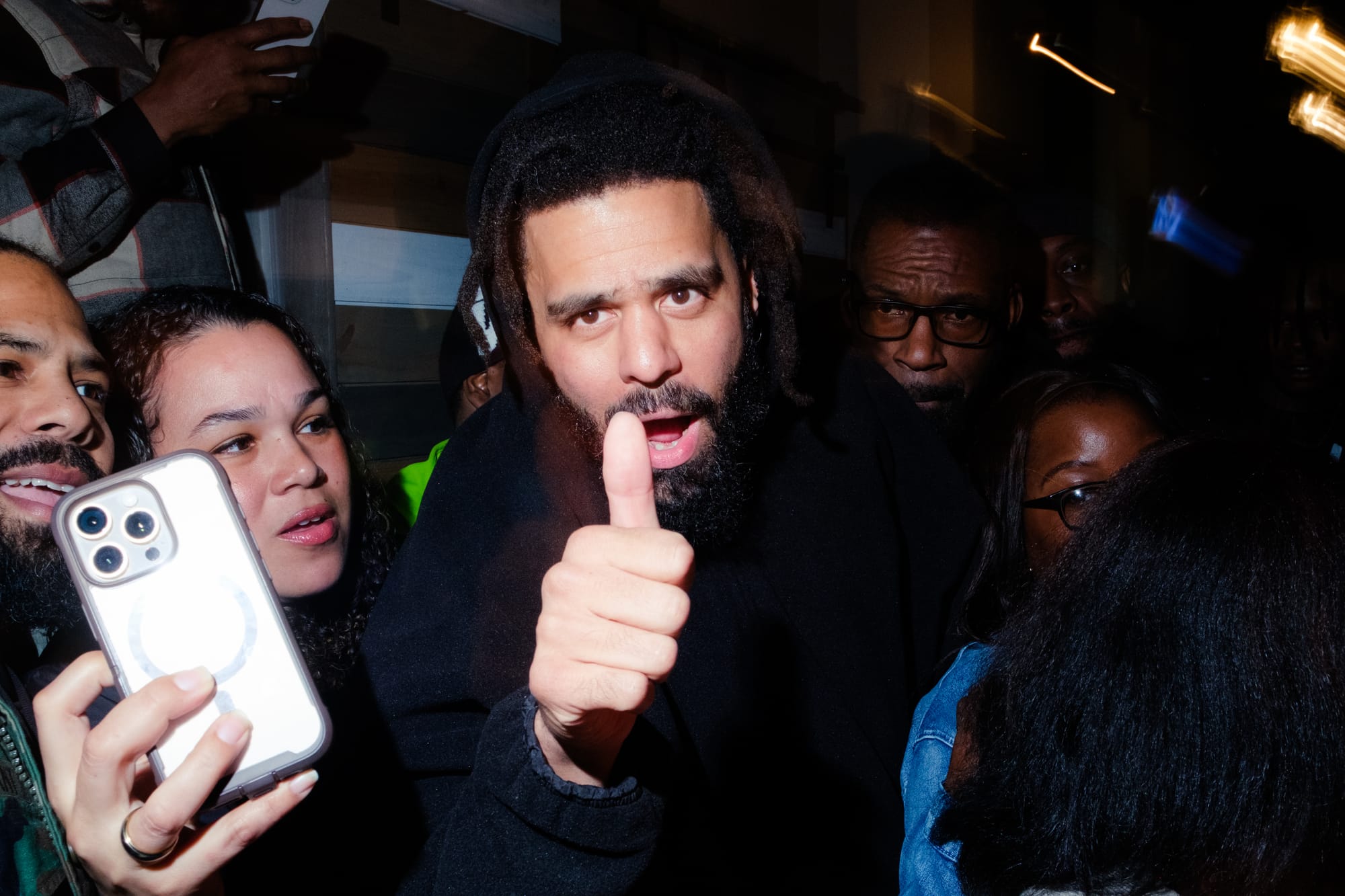
It took him and his security team almost 20 minutes to get from the front door to the convoy of black sprinter vans parked just across the street, the call-and-response of “Two Six” and “AnnnANT!” trailing behind him. Suddenly, he was gone, his fleet of vehicles cruising north. People stood in disbelief, some assuring their friends they knew he’d show up, others stunned into silence.
It felt like a gift, a fitting cap to the rollout of an album made by one of them, for them, on their day. “He made it cool to say, ‘I’m from the ‘Ville,’” said Jones, camera and press credentials hanging around his neck. “It’s not a lot here, but I’m from here. It’s my city.”

Dash Lewis, born in Wilmington and raised in Durham, is a musician and culture writer now based in Richmond, Virginia. He writes primarily about hip-hop, electronic music, and literature for outlets like Pitchfork, Stereogum, The Guardian, and The Sun Magazine.