
Generational Talent
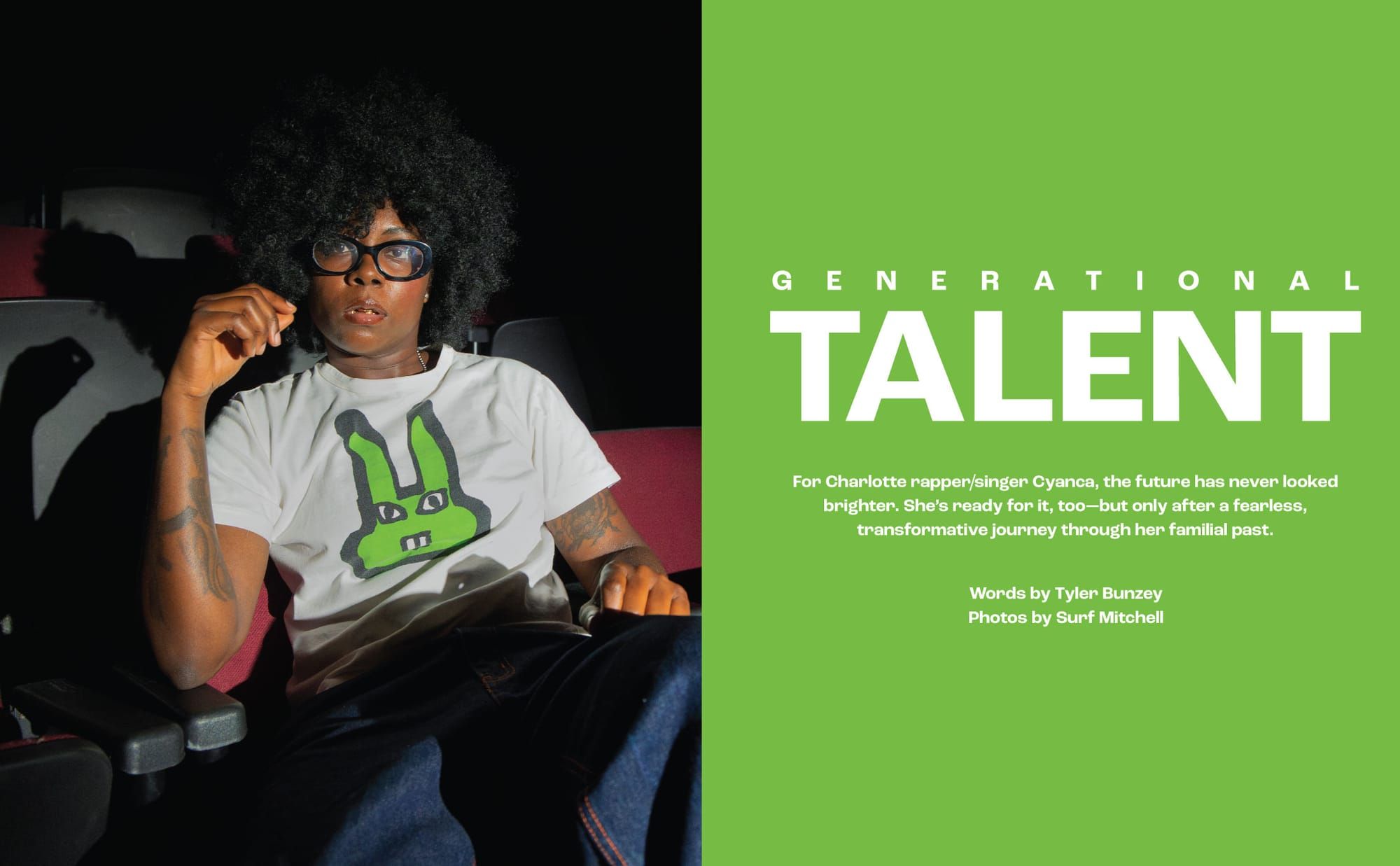
For Charlotte rapper/singer Cyanca, the future has never looked brighter. She’s ready for it, too—but only after a fearless, transformative journey through her familial past.

This story is re-published from Issue 1 of Super Empty Magazine (S/S '26), released April 8, 2026.
“If you can find the crossroads, a crossroads, this crossroads—if you can make an archeological dig into this crossroads—you’ll find fragments, technofossils. And if you can put elements together, those fragments, together, you’ll find the code. Crack that code, and you’ll have the keys to your future. You have one clue. It’s a phrase: mothership connection.”
– Edward George, The Last Angel of History (1995)

Cyanca has the keys to the future.
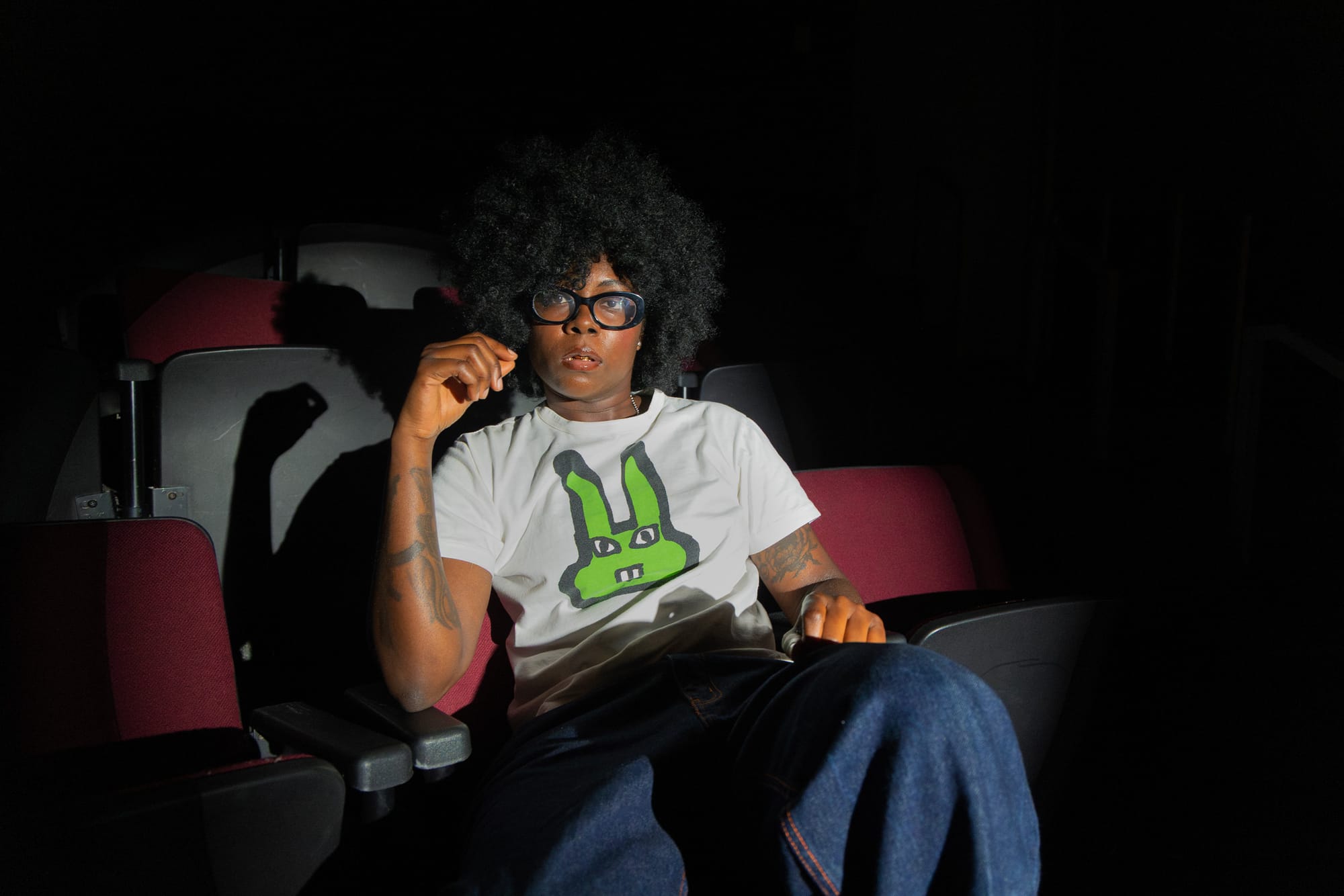
When she arrived at the Mint Museum Randolph for our shoot with photographer Surf Mitchell last summer, she exhibited the same humble, soft-spoken demeanor that I’ve gotten to know over the last few years. But as soon as the camera started clicking, her presence rapidly expanded through the lens, transforming the museum auditorium into a one-woman stage.
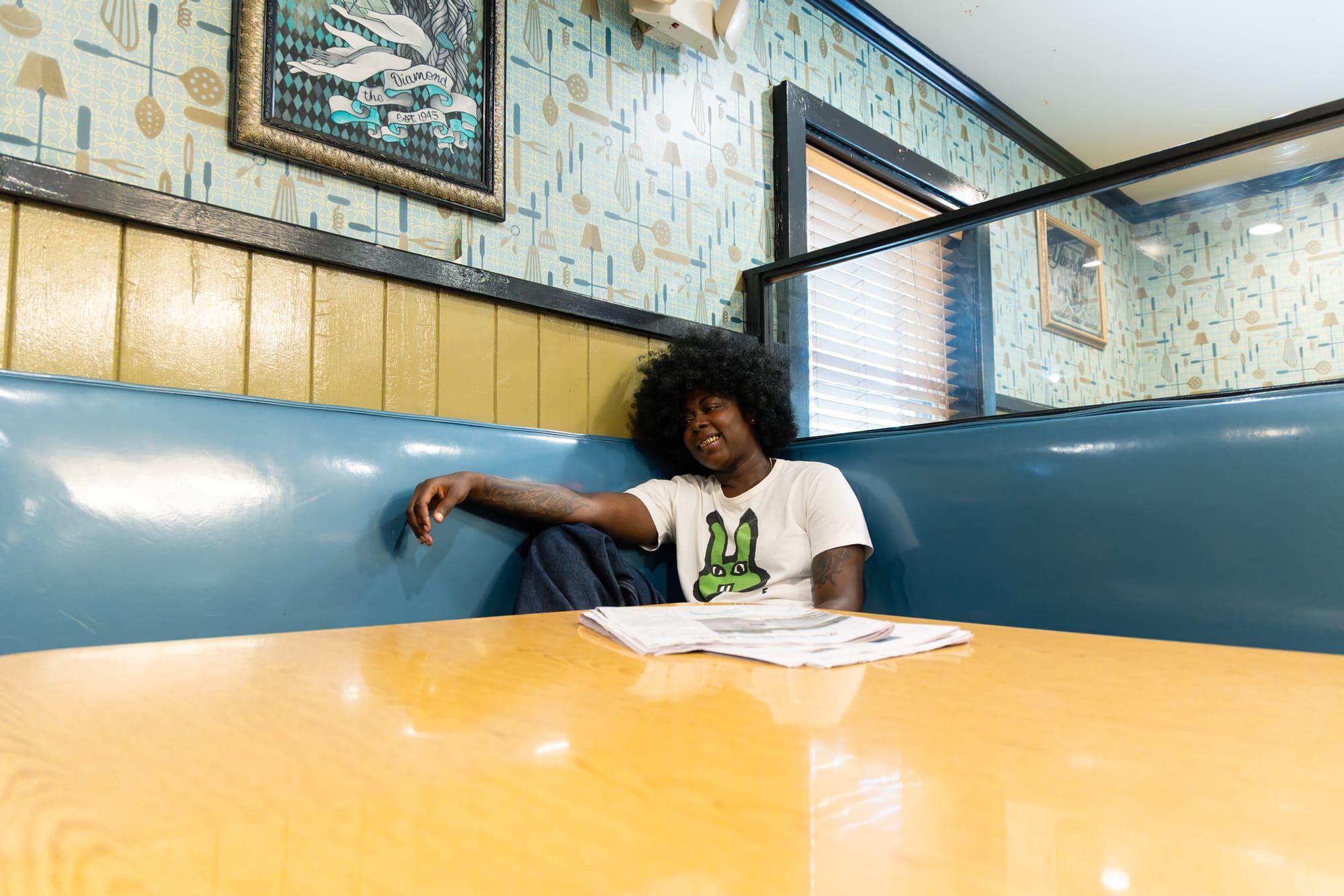
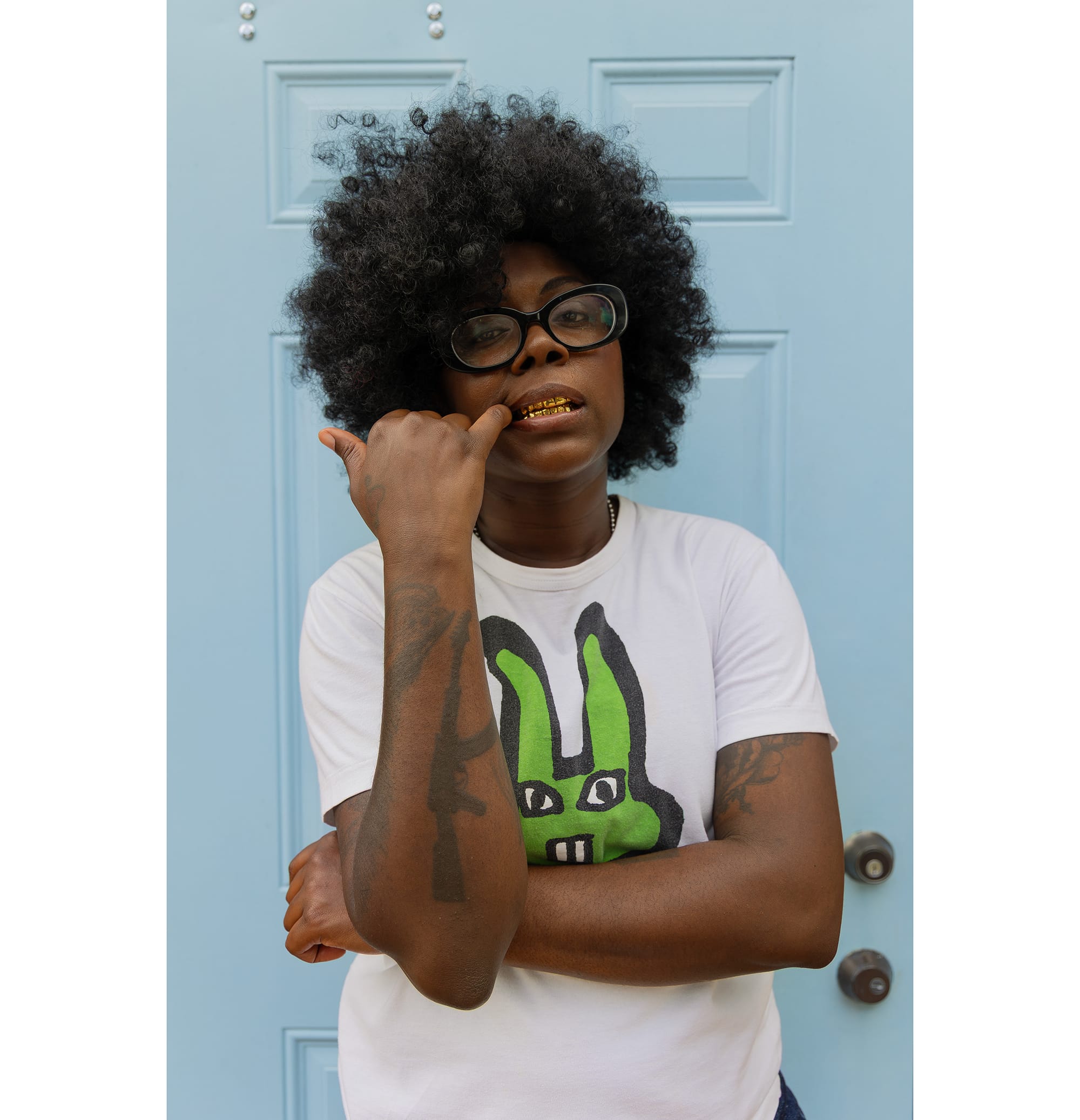
When we relocated to Plaza Midwood, she conjured the magic once again. We chatted casually about her album, her performance with the NYC-based freestyle channel On The Radar, our mutual friends. Just catching up. Then, almost without warning, she would raise her gaze and transform the air around her with each snap—every soft smile or mean mug accentuated by gleaming gold grills and a full ensemble that included an afro wig, wide leg jeans, and a white graphic tee from COMME de GARCONS. Petra’s, Diamond Restaurant diner, even just a brick wall—each prickled around the singer, as if we’d constructed a set just for her.
After a couple of hours, she had to leave. We hugged, and she slipped off to her next sojourn through an early evening summer storm. Had Surf not captured these moments, it would be easy to think that I had made them up.
Cyanca’s space-defining sorcery in front of the camera reminds me of the Data Thief, the fictional protagonist from director John Akomfrah’s experimental 1995 Channel 4 film, The Last Angel of History. Part documentary and part speculative fiction, the film follows the Data Thief as he skips through the portals of history, travelling to and through the sounds of Sun Ra, George Clinton and the Parliament Funkadelic, and house producer Derrick May.
As he travels, the Data Thief’s task is to find out who he is through these sounds, these fragments of past and future. One of the first explicit articulations of Afrofuturism, The Last Angel of History argues that the histories that we often discard—those articulated through the bizarre, the outcast, and the extreme—contain the codes to break through to new futures. Ralph Ellison phrased it more simply in the infamous prologue to his 1952 opus, Invisible Man: “the end is in the beginning and lies far ahead.”
•••
Born Donshakaria Sanders, Cyanca’s story didn’t start in the Queen City. She was raised in Smithfield, NC surrounded by her extended family, who imbued her with a love of music through a deep involvement with the church. From the time her dad gifted her a drumset at age six, she was always interested in self-expression through music. When she eventually left for college, it was to pursue a music degree at UNC Greensboro. (She later switched to Business Administration and Management, graduating in 2011).
Cyanca’s music career didn’t officially begin until she moved to Charlotte in 2016 for a job promotion. With the stability and resources to pursue her music more intensively, she released her debut EP, Isle of Queens, the following year. This EP–anchored by what would become her most prominent song “New Phone, Who Dis?”—helped her to quickly establish herself as a force on the local scene.
Across two more projects and a handful of singles in the years that followed, she further honed a convention-bending sound that bridges the hip-hop emcee’s audacious self-confidence with an R&B diva’s interior gaze. Her artistic ethic could be summed up with the hook from her 2024 single “My Bad”: “I ain’t got no rules, yeah — my bad/ I don’t care what you consume— my bad.”
Now in her mid-thirties, Cyanca is bending, like the Data Thief, through the portals at the crossroads. Our futures and histories are determined by a complicated palimpsest of place, power, and prosperity. Who we are and where we come from are never simple questions to answer, no matter how sure we may feel of either one. But on her forthcoming album, KATINA, the Charlotte trailblazer is inching ever closer, by leaning into one of the most fundamental portals for such self-discovery: family.
Hers is a more fraught journey than most. Cyanca’s access to familial identity was fractured when she lost her mother to an accident at two years old. Four years later, she would lose her yet again, this time in the form of a house fire that stole photographs, tapes, and other mementos carrying some of the last points of connection to her mom. The compounding grief opened a void, the kind that comes from being denied a full familial archive, and the lifetime of memories that might shape one’s sense of self.
“I felt lost for a long time,” she said to the crowd at a preview party for KATINA last April at Uptown’s Gallery House, her voice tight with the admixture of nerves and emotion. “Then I was so afraid to learn things because I felt like if I Iearned something, I would miss her more.”
Eventually, though, she began to ask family members and her mother’s old classmates about what her mother was like. She wanted to know everything. What was her favorite food? What was her zodiac sign? What did she do for fun? Did she travel? What was it like to know her? She started peering ever more fearlessly into the void, even exploring what her family members remembered about the night of her mother’s accident.
“It was scary territory for me to enter,” she told me over coffee, a few months after the listening party. “As I'm getting older, I'm realizing that I am healed enough. I am strong enough to enter that space about her. I wanted to create a project that honored her in a very cool way.”
To anyone who’s followed her musical journey over the last eight years, the specifically maternal exploration may be new, but the familial focus comes as little surprise. As Cyanca herself put it, “My whole brand has been centered in some way around family.” Indeed, her grandmother graces the cover art of the Durand Bernarr remix to “New Phone, Who Dis?,” a remix that she got to perform live at Bernarr’s May 19th tour stop in Charlotte last spring. The cover art for “My Bad”—celebrated by, among others, Missy Elliott—features her cousin Ryan.
She’s also quick to point out that KATINA isn’t a simple reference to her roots or even a contemplative meditation on her mother in the vein of 2Pac’s “Dear Mama.” Instead, she wanted to unearth Katina’s identity by excavating how her mom’s qualities live on through her. On the album, you won’t hear many, if any, explicit references to the real-life Katina. As she explained at the listening party, “I came up with this concept, like, if [she] was alive, what would her sound be?”
By the time of our midsummer shoot with Surf, it seemed that the release of KATINA was imminent. Coming off a performance of her sultry single “Down” with On The Radar, an ad placement with HOKA footwear, and her first performance at Dreamville Festival, Cyanca seemed poised to maximize the impact of some of her most intimate and stylistically risky work to date.
•••
The twists of time surprise us all, even chrononauts like Cyanca. Not long after we sat down to talk all things KATINA in June, a path that had remained elusive through the first decade of her career finally opened up. Her team at Cover Art Entertainment, a Santa Monica-based artist management firm she’s worked with since 2023, saw potential in her On the Radar performance as it began to do serious numbers in June. Some labels took interest, and Cyanca’s team began courting opportunities that would help her elevate her creative vision while preserving the freeform experimentation that lends her work its particular quality. After a few weeks and myriad meetings, they found what they were looking for: a distribution deal with Sony imprint Santa Anna Records.
Far from the mere serendipity of smiling fates, the deal bloomed from seeds painstakingly sown over the last decade. Around 2016, just before the release of Isle of Queens, she had her first major-label encounter with Roc Nation, through a connection with Jay-Z’s nephew. That tide temporarily ebbed, but flowed back in 2017 after Teen Vogue covered the EP’s release.
Even as she made modest industry inroads, she still felt her outsider status. “Of course, I've talked to labels before, but it's always been us reaching out to them,” she explained. “So their whole energy is like, ‘Oh, who is this other artist that's on my desk today?’ It wasn't that they found me and were interested.”
But in 2019, Issa Rae’s music label, Raedio—then a subsidiary of Atlantic Records—reached out to talk about working with Cyanca through both the label structure and through sync deals with Rae’s hit show Insecure, famous for Rae’s taste-making episode scoring. The pandemic had other plans. Cyanca found herself in a career reboot as the entertainment industry’s revenue streams from filmmaking, ad placement, live performance, and studio recording dried up almost overnight.
Years later, as she prepared for the release of her debut album Late 2 the Party in 2023, a film company in L.A. named Made For More Entertainment reached out to do a sync deal for her perennial, sleeper hit from 2017, “New Phone, Who Dis?” Connecting over the founders’ family roots in North Carolina, they hit it off, leading to a longer conversation about her career and connections. When they asked about her manager, Cyanca told them that she managed herself. In disbelief, the firm snapped into action for her: “They was like, we got you. You need a manager. You’re too talented.”
Made for More’s co-founder, David Hunter, linked her with Mark Harris of Cover Art Entertainment. Harris was no newbie to the industry. As the former head A&R for Trauma.2 Records—a relaunch of the same Interscope subsidiary that released Shaquille O’Neal’s rap albums in the ‘90s—he had managed superproducer Brody Brown and co-written for Bruno Mars and Adele. His partner at Cover Art, Larry Frazin, had helped architect the careers of artists like Paula Abdul, No Doubt, and Josh Grobin. It was a team, in short, with the experience to get Cyanca where she wanted to go.
Two years in, the relentless advocacy from Harris and the Cover Art team finally paid dividends when it resulted in the deal with Santa Anna, home to fast-rising acts like LAZER DIM 700, Raq Baby, and more.
The development brings a great deal of relief to Cyanca, who’s worked for the better part of a decade to corral the resources that would help her elevate her artistic vision. When we chatted, I watched her shoulders visibly relax as she said, “It was just like, ‘Thank God!’ Because I’ve been doing this for so long, independent, as a Black woman, paying for everything.”
Far from a 360 deal, the Santa Anna partnership enables Cyanca to have a team behind her to help figure out logistics. It grants access to gatekept industry spaces like label rooms, playlists, and booking processes. Most importantly, perhaps, it provides resources for the massively creative singer to expand her artistic practice without ceding creative control or publishing rights.
When I asked her what she was most excited to get out of the deal, she responded with a chuckle: “Cyanca gets in the system.” But perhaps, more importantly, she reflected that now, “I allow my art to lead. I try not to be in the way of the art, and that’s the way I’m growing right now."
Although the Santa Anna deal delayed the release of KATINA, she still plans on releasing the project in early 2026—though not in the same form we heard it at the listening party months ago. She’s recorded seven more songs and plans on splitting the original project up into an album and an EP, or maybe even a series of singles. The world is her oyster, and she’s busy sharpening her oyster knife: “I ain’t gonna be like, ‘Oh, just because I’ve got the freedom to drop whenever, I’m going to take advantage [and relax].’ Like no, I’m dropping ASAP.”
•••
Just as Cyanca isn’t going to drop whenever just because she can, she isn’t forsaking the community that has propelled her to this point either. KATINA, in all of its forms, has been a project that highlights the best of artistic exchange in North Carolina, with collaborations featuring fellow Charlotteans Garrett Sparrow and Maximillian Leonard of alt hip-hop trio Biking With Francis, producer Benjamin Burdon, and Raleigh multihyphenate Mez.
Perhaps no figure has been more significant to the community surrounding Cyanca’s recent releases than Jeff Thompson, professionally known as Jeff on the Boards. (According to the singer, Jeff “basically A&R’d” the upcoming project.) Indeed, his fingerprints are all over KATINA. He connected her to the architects of the project’s soundscape from the Biking With Francis crew to Chicago’s Nico the Great, often lending his hand through the recording process as well.
Asked why he put so much intention into helping Cyanca craft her project, the producer is effusive in his praise: “I think that she is special as a Black woman who's trying to push the boundaries of just music, sound, ideas, fashion. I don't think that there's necessarily a limit for her.”
When we chatted about how she felt about the Charlotte scene and her role in it, she reflected, “I'm getting older, so I'm learning about the value of making substance within the world, putting out positive things, and understanding who I am and what I mean to people in advance. I’m making sure I'm impacting them in the right way.”
Like the archaeological identity work that fueled it, Cyanca’s newest chapter is bigger than just her. As she rises, so do those who’ve been following behind her for years. “Cyanca, to me, is like the soul of North Carolina, the soul of Charlotte,” Reuben Vincent, one of the young cornerstones of Charlotte hip-hop, told me. “Honestly, she’s one of the biggest glues that hold the whole city together, the whole culture together.”
You’d be hard pressed to find a past or current collaborator of Cyanca’s who disagrees. While her creative practice is always impressive, this period of her career is special because of the folks she’s taking with her. “As long as she's open and her mind is open, I think that she can do anything,” Jeff said. “She is a unicorn.”
•••
Like the Data Thief in The Last Angel in History, Cyanca is ever the trickster, slipping through time and space to collect the fragments that lead us into the future. The mothership connection, in this case a metaphor that’s more literal than celestial, has lent her the power to refigure herself in the process of making her most stylistically unbridled album. Combined with a long-sought, industry-stamped distribution deal, it could be the rocket fuel that shoots her into the new dimensions that she’s been aiming at for years.

Tyler Bunzey is an educator and music journalist who's covered queer pop, R&B, and more for places like CLTure and QC Nerve, and wrote two of the features (on Cyanca and Gordon Holliday, respectively) in the debut issue of Super Empty magazine. He runs the Cultural Studies major program for Johnson C. Smith University. He can be found on Twitter/X at @t_bunzey.
Kevin "Surf" Mitchell is a Charlotte born-and-raised photographer whose work has appeared in outlets like BET, MTV, and Apple Music, and an instructor at The Light Factory Photo Arts Center in Charlotte. You can follow him on Instagram at @surfmitchell.